
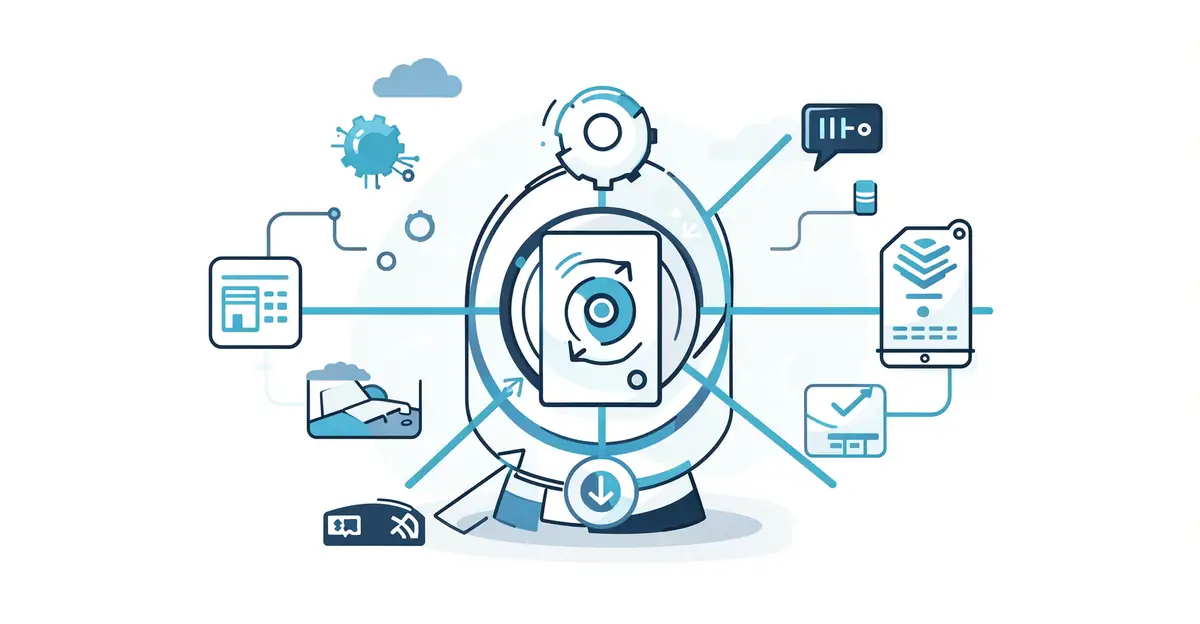
The Internet of Things (IoT) is the network of everyday devices—from smart thermostats to fitness trackers—that connect to the internet to collect and share data. It transforms ordinary objects into intelligent tools that respond to your needs in real time.
But how does it actually work? In this article, we break down the Internet of Things in simple terms, explaining the sensors, connectivity, and data processing behind it—plus practical ways you can use IoT to simplify your daily life.
Introduction
The Internet of Things, often shortened to IoT, is one of those phrases that gets used everywhere—smart homes, fitness trackers, factory floors, city traffic lights—yet many people would struggle to explain exactly what it means. At its core, the Internet of Things refers to the vast network of physical objects that are embedded with sensors, software, and other technologies for the purpose of connecting and exchanging data with other devices and systems over the internet. This article explores What Is the Internet of Things and How Does It Work with clear, practical guidance. Whether you are a curious beginner, a small business owner, or someone considering a smart home upgrade, understanding the fundamentals will help you navigate a world where everyday objects increasingly talk to each other.
The term “Internet of Things” was coined by Kevin Ashton in 1999 while working on supply chain optimization. What began as a way to track inventory has exploded into a global phenomenon. Estimates suggest there are already tens of billions of connected devices worldwide, and that number continues to climb. But behind the buzzwords lies a straightforward concept: take an ordinary object, give it the ability to sense its environment, connect it to a network, and let it share information. That simple idea powers everything from a smart thermostat that learns your schedule to a soil sensor that tells a farmer exactly when to water crops.
Why should this matter to you? Because IoT is no longer a futuristic novelty. It influences the products you buy, the energy you consume, the healthcare you receive, and the way cities operate. Understanding the fundamentals of What Is the Internet of Things and How Does It Work helps you make informed decisions—whether you are choosing a security camera, managing a business, or simply trying to keep your personal data safe. Reliable information and consistent habits lead to better long-term outcomes, both in technology and in life.
Key Concepts
Before diving into mechanics, it helps to grasp a handful of foundational ideas. These concepts form the vocabulary you will encounter repeatedly when reading about IoT.
Devices and Sensors
An IoT device is any physical object equipped with sensors, actuators, or both. Sensors collect data—temperature, motion, light, humidity, location, acceleration. Actuators act on that data—locking a door, turning on a light, adjusting a valve. A smart doorbell, for example, combines a camera sensor, a microphone, and a speaker (an actuator for sound) to let you see and talk to visitors remotely.

Connectivity
For a device to be part of the Internet of Things, it must communicate. Connectivity can take many forms: Wi-Fi, Bluetooth, cellular (4G/5G), Zigbee, Z-Wave, LoRaWAN, or even wired Ethernet. The choice depends on range, power consumption, bandwidth needs, and cost. A fitness tracker might use Bluetooth to sync with your phone, while a remote agricultural sensor might rely on a low-power wide-area network to transmit readings across miles of farmland.
Data Processing
Raw sensor readings are rarely useful on their own. Data must be processed—filtered, analyzed, and turned into actionable insights. This can happen locally (edge computing), in the cloud, or in a hybrid model. Edge computing reduces latency and bandwidth use by making decisions near the source, such as a smart camera recognizing a package thief without sending video to a server.
User Interface
Finally, humans need a way to interact with the system. That could be a mobile app, a web dashboard, a voice assistant, or even an automated alert. The interface translates complex data streams into something you can understand and act upon.
- Thing: Any physical object with a unique identifier and network connection.
- Sensor: A component that detects changes in the environment.
- Actuator: A component that causes a physical change.
- Gateway: A bridge that connects IoT devices to the internet or a central system.
- Cloud platform: A service that stores, manages, and analyzes IoT data.
- Edge computing: Processing data near the device rather than in a distant data center.
Deep Dive
Now that the vocabulary is clear, let us walk through how IoT actually works end to end. The process generally follows a familiar pattern: sense, connect, process, act, and learn.
Sensing the Environment
Every IoT system begins with data capture. Sensors convert physical phenomena into electrical signals. A temperature sensor might output a voltage that corresponds to degrees Celsius. A motion sensor might send a digital pulse when infrared light changes. These signals are often analog, so a microcontroller or microprocessor digitizes them into machine-readable form.
Connecting and Transmitting
Once data is digitized, the device needs to send it somewhere. This is where connectivity protocols come in. Wi-Fi is common in homes because it is fast and ubiquitous, but it drains battery quickly. Bluetooth Low Energy is efficient for short-range wearables. Cellular networks offer wide coverage but require subscriptions. Zigbee and Z-Wave create mesh networks where devices relay messages for each other, extending range without a central hub. LoRaWAN and NB-IoT are designed for low-power, long-range applications like smart meters and asset tracking.
Security at this stage is critical. Data should be encrypted in transit using protocols like TLS. Devices should authenticate with the network to prevent unauthorized access. Unfortunately, many cheap IoT gadgets ship with weak default passwords, which is why botnets like Mirai were able to hijack hundreds of thousands of cameras and routers. Being aware of this risk helps you choose better products.
Processing and Analyzing
Once data reaches a gateway, cloud platform, or local server, software goes to work. Rules engines can trigger simple if-this-then-that actions: if motion is detected after 10 PM, turn on the porch light and send a notification. More advanced systems use machine learning to find patterns. A smart thermostat might learn that you like the house at 68°F in the morning and 72°F in the evening, then adjust automatically. Predictive maintenance systems on factory equipment analyze vibration data to warn of a failing bearing days before it breaks.
Acting and Automating
The “action” phase is where IoT delivers value. Actions can be simple (unlocking a door) or complex (coordinating traffic signals across a city to reduce congestion). In industrial settings, actuators might adjust conveyor speeds or open valves. In healthcare, an insulin pump might deliver a dose based on continuous glucose monitor readings. The key is that the loop closes: sense, decide, act, and then sense again to see the result.
Learning and Improving
Modern IoT systems often include a feedback loop. Data from actions is collected and analyzed to improve future decisions. This is how recommendation engines, autonomous vehicles, and smart grids get smarter over time. The more reliable the data and the more consistent the monitoring, the better the outcomes.
- Consumer IoT: Smart speakers, wearables, home security, appliances.
- Commercial IoT: Retail analytics, inventory tracking, smart offices.
- Industrial IoT (IIoT): Manufacturing, agriculture, energy, logistics.
- Infrastructure IoT: Smart cities, traffic management, utilities.
Best Practices
Whether you are deploying a single smart device or managing an enterprise fleet, a few best practices can save you time, money, and headaches.
Start Small and Scale Gradually
Do not try to automate your entire home or factory in one weekend. Begin with one or two use cases that solve a clear problem. Learn the quirks of the platform, then expand. This reduces risk and lets you build confidence.
Prioritize Security from Day One
Change default passwords immediately. Enable two-factor authentication where available. Keep firmware updated. Segment your IoT devices on a separate network from your primary computers and phones. If a device does not receive security updates, think twice before connecting it to the internet.
Choose Interoperable Standards
The IoT market is fragmented. Devices from different brands often do not talk to each other. Look for products that support open standards like Matter, Zigbee, or MQTT. This future-proofs your investment and reduces the chance of being locked into a single vendor.
Plan for Power and Connectivity
Battery life and network reliability are common pain points. Estimate how often a device will transmit data and choose a protocol that matches. A door sensor that sends a signal only when the door opens can last years on a coin cell, while a security camera streaming video needs constant power and high bandwidth.
Respect Privacy
IoT devices collect intimate data—when you wake up, what you eat, where you drive. Read privacy policies. Disable data collection features you do not need. Be cautious with always-on microphones and cameras. Your data is valuable, and you have a right to control it.
- Document your devices, their IP addresses, and update schedules.
- Use a dedicated IoT VLAN or guest network.
- Regularly review app permissions and connected accounts.
- Back up configurations so you can restore after a failure.
- Monitor for unusual traffic that might indicate a compromise.
Step-by-Step Guide to Getting Started with IoT
If you are ready to move from theory to practice, follow these steps. They apply whether you are setting up a smart home or piloting an industrial sensor network.

Step 1: Understand the fundamentals
Before buying hardware, make sure you can explain how sensors, connectivity, data processing, and actuation fit together. Read reliable sources, watch tutorials, and identify the specific problem you want IoT to solve. Without this foundation, you risk buying incompatible or unnecessary gadgets.
Step 2: Assess your starting point
Take inventory of your current environment. What devices do you already own? What network infrastructure is in place? What is your technical comfort level? For a home user, this might mean checking your Wi-Fi coverage and router capabilities. For a business, it means auditing existing equipment, data systems, and IT policies. Knowing where you are prevents unrealistic plans.
Step 3: Set clear goals
Define what success looks like. “Reduce energy bills by 10% within six months” is a clear goal. “Make my house smart” is not. Write down specific outcomes, timelines, and how you will measure them. Goals keep you focused and help you justify the investment.
Step 4: Gather necessary resources
This includes hardware (sensors, hubs, gateways), software (apps, platforms), connectivity (Wi-Fi, Zigbee, cellular), and people (yourself, family members, IT staff, or consultants). Budget not just for purchase but for ongoing subscriptions, batteries, and replacement.
You now have a solid foundation for What Is the Internet of Things and How Does It Work. Apply the best practices above and revisit this guide as your needs evolve.